
Getting Lake County Court Records
The main online channel for a District Court or County Court case file is the Colorado Judicial Branch Record/Document Request Form. Pick Lake County. Add the case number and filing year if you have them, list the parties, and name the item you need. The form covers a Register of Action, a complaint or information, a disposition or sentence order, a protection order, judgment papers, family and probate records, plus a free-form line for anything else. Check the certification box only if you need an authenticated copy. Expect a reply within three business days. Retrieval, redaction, or a large request can stretch that out.
The clerk also takes requests by email at LakeRecordsRequest@judicial.state.co.us, by mail at P.O. Box 55, Leadville, CO 80461, or in person at 505 Harrison Avenue. Call 719-293-8100, extension 9. Or call the clerk at 719-293-8105. Ask about procedure, counter hours, and whether a public terminal exists. The local page makes no promise on that score, so check before you drive over. A paid approved vendor sells an unofficial real-time register of actions. The free statewide docket search shows only calendar entries. Neither one hands you official filed copies.
- Identify Lake County District Court, Lake County Court, or Leadville Municipal Court as the court that holds the case.
- Collect the party name, filing year, case class, and case number, then decide whether an ROA, filed paper, or certified copy is needed.
- Submit the Judicial Branch form, email the Lake County records desk, mail the request, or take it to the Combined Court counter.
- Use the court phone line if the case cannot be found, the deadline is close, or access may require identification.
- Review the clerk's cost notice, approve any retrieval or research charge, and arrange payment and delivery during fulfillment.
Leadville ordinance cases take a separate path. City Hall holds those files, and the Municipal Court clerk answers at 719-656-0637. For Lake County administrative records, use the county's CORA form, but do not confuse that route with a court-case request. They are not interchangeable.
Lake County Court Record Form
No case number? The state form still works. Supply party names, a year, the case type, the Lake County location, and any detail that helps the clerk pull the right file. You can request specific civil, criminal, family, or probate documents, and the form carries a separate option for the Register of Action. Be ready for one more step in sensitive matters. Suppressed cases, juvenile matters, probate files, and protected information may require a United States government-issued photo ID.
| Form field | How it helps | Status |
|---|---|---|
| Case Number | Points to the exact year, class, and sequence | Optional if unknown |
| County/location | Routes the request to Lake County | Select Lake County |
| Party Information | Identifies names attached to the case | Required |
| Document choices | Names the order, ticket, judgment, or ROA sought | Select as needed |
| Certified/exemplified | Requests clerk authentication | Optional |
Precision pays off here. Writing "Disposition/Sentence Order" gets you the signed result; writing "ROA" gets the chronological index. A request for "everything" invites more copying, review, and redaction, so it costs you time. One more wrinkle matters for old files. The record may sit in off-site storage. If so, you may have to approve the actual retrieval cost before the clerk starts work.
Court Record Types
One Combined Court clerk serves two state trial courts in Lake County. The District Court side holds felony, general civil, domestic-relations, juvenile, probate, and water files. County Court handles misdemeanors, traffic, small claims, and county civil actions. Leadville Municipal Court keeps city-ordinance cases on its own shelf. The case type decides the clerk you contact. It also decides the access rules that apply.
- Registers of actions that list filings, minute orders, settings, rulings, and disposition events in date order.
- Complaints, informations, petitions, answers, motions, and other filed pleadings.
- Signed orders, disposition or sentence orders, decrees, judgments, and satisfaction documents.
- Tickets, protection-order papers, probate documents, and family documents offered on the state request form.
- Certified or exemplified copies bearing the clerk's authentication.
A transcript is not a copy you can order like anything else in the file. Most 5th Judicial District proceedings are digitally recorded, though many District Court criminal matters may still use a court reporter. To get spoken testimony, go through the authorized transcript channel the court identifies.
Three Lake County Record Layers
Three layers answer three different questions. The Colorado Judicial Branch Docket Search is the schedule layer. It finds a hearing by date, with filters for location, case, party, attorney, or division. What it cannot do is hand you pleadings or the complete official history. The middle layer is an approved vendor's real-time register of actions. That index lists entries in chronological order. Treat that one carefully. The Judicial Branch warns that vendor data can be incomplete or wrong. It is not the official record.
- Docket or calendar
- A free list of public court settings that answers when and where a matter is scheduled.
- Register of Actions
- The chronological case index summarizing filings, minute orders, hearings, rulings, and the recorded outcome.
- Filed document
- The actual complaint, order, judgment, decree, ticket, or other paper whose words control.
- Certified copy
- A copy authenticated by the clerk, subject to the same access limits as the original.
Begin with the cheapest layer that answers your question. A court date may need nothing more than the free calendar. A procedural history calls for an ROA. To read the terms of a ruling, get the signed order. Need formal proof? Only a certified copy from the Lake County Combined Court clerk will do.
Inside a Lake County Court Record
Every Lake County case file hangs on its Colorado case number. The usual pattern blends a four-digit filing year, case-class letters, and a sequence. The state form shows 2023AA123456 as an example. Traffic cases often follow a pattern like 2019T999999. The actual paper controls the class. Common letters include CR for District criminal, M for misdemeanor, T for traffic, CV for District civil, C for County civil, S for small claims, DR for domestic relations, JV for juvenile, and PR for probate.
| Case Header | Case number, court, county, division, caption, filing date, and status. |
|---|---|
| Party Blocks | Party roles and associated counsel, subject to privacy limits and redaction. |
| Chronology | Filed papers, service, motions, minute orders, settings, rulings, and disposition events. |
| Criminal Material | Public charge, bond, plea, disposition, and sentence information where available. |
| Civil Material | Claims, judgments, satisfaction filings, and post-judgment writ activity. |
| Document Images | Not supplied by the free state calendar or vendor ROA; copies come from the clerk. |
Remember that the ROA is only an index, not the filed paper. A "Disposition Hearing" entry proves the setting had that label, nothing more. It does not establish any result. Before you state an outcome, request the signed disposition or sentence order. Civil cases work the same way. A motion is a request, and the later order is what records the judge's decision.
Lake County Court Record Clerk
Two public counters operate inside 505 Harrison Avenue in Leadville. Only one of them holds state court files. Chelsea Prugh is the listed Clerk of Court for the Lake County Combined Court. She also serves as the local ADA coordinator. Her office sits within the Colorado Judicial Department. It keeps the records of Lake County District Court and Lake County Court. The elected Lake County Clerk and Recorder occupies the same building. That office handles deeds, elections, vehicles, titles, and county-board business, not the court docket.
Lake County Combined Court Records
505 Harrison Avenue
P.O. Box 55
Leadville, CO 80461
719-293-8100 ext. 9
Clerk: 719-293-8105
Route your request to the right office. A District Court judgment, a County Court ticket, or a certified ROA belongs with the Combined Court, not the elected Recorder. Leadville ordinance cases go to the Municipal Court clerk instead. Sending a records request to the wrong government office slows things down. It also yields no judicial record. The two Leadville counters share one street address yet serve entirely different legal records.
Fees and Certified Copies
A plain copy just duplicates what was filed. Certification is different. The Lake County court clerk adds an official authentication to a certified or exemplified copy, which is why it costs more. Keep two limits in mind. Certifying a document never overrides a restriction, so a sealed filing stays sealed even with a clerk's stamp, and the fee applies to each document rather than each case. Payment and delivery methods get worked out with the clerk during fulfillment, so call before you mail a check.
| Lake County court record item | Current amount |
|---|---|
| Plain copy, each page | $0.25 |
| Certified or exemplified copy, per document | $20 |
| Name search | $5 |
| Transcript of Judgment | $25 |
| Certificate of Satisfaction | $20 |
| Research or redaction | $30 per hour, in 15-minute increments after the first hour |
| Off-site retrieval | Actual retrieval cost |
Fees depend on who is asking. Parties and their attorneys pay no more than $15 for copies pulled from their own case. That cap disappears for a nonparty request. Walk-up self-service copies run $0.25 per single-sided page and $0.50 per double-sided page. Faxing runs $1 a page. The current Judicial Branch fee materials list all of these amounts. A single order can stack certification or retrieval charges on top when both services are needed.
Lake County Court Record Transcripts
The 5th Judicial District records most proceedings digitally. Some District Court criminal matters still use stenographic court reporters instead. Under a 2024 district order, raw electronic recordings are not routinely released. Courtroom microphones can pick up confidential attorney-client communication. The proper route to spoken testimony is an authorized transcript. It is prepared through the reporter or transcription process the court directs.
A clerk photocopy is not a transcript. The case file holds pleadings, orders, notices, and minute entries. None of that converts the audio of a hearing into a word-for-word record. Say in your request whether you want the filed minute order, the signed ruling, or the spoken proceeding. The clerk can then route you to the right reporter or approved transcriber.
Older Lake County files may sit in off-site storage. The clerk retrieves them at actual cost. A large or sensitive file can require staff research and redaction first. Plan for both steps. A three-business-day ordinary response time does not promise quick delivery. A long archived file must be copied, reviewed, and certified, and that may not happen within that same window.
Sealed Records and Public Access
Access rules come from Chief Justice Directive 05-01, not from the county's general administrative-record form. The directive balances reasonable public access with privacy protection. Colorado treats public access and free remote access as separate things. Do not expect every image online. Trial-court case documents are not directly viewable through the public Judicial Branch website. The clerk may redact protected identifiers before releasing a copy of a Lake County court record.
Lake County access rules:
Chief Justice Directive 05-01 governs inspection, copies, and electronic access to Judicial Branch court records.
C.R.S. §13-32-104 supports the court copy and certification charges reflected in the official fee list.
Colorado Title 19 restricts juvenile and child-welfare information beyond ordinary adult public files.
Colorado files its electronic records at several security levels: public, protected, restricted, suppressed, and sealed. A protected filing can open up once the required redactions are made. Restricted and suppressed items reach only narrow groups of viewers. Sealed material carries the tightest limits of all. Juvenile records, some probate and family files, and protection-order cases may demand identification or proof of legal authority. Only then will the Lake County clerk release anything. Keep one caution in mind when a docket search comes back empty. A missing online result does not mean no Lake County case exists.
Lake County and Federal Court Records
Federal cases tied to Lake County never land in the Lake County Combined Court file. They sit elsewhere instead. Those go to the U.S. District Court for the District of Colorado, the U.S. Bankruptcy Court for Colorado, or a federal appellate court. The District of Colorado posts official PACER access information for anyone who needs it. PACER works differently from Colorado's free state calendar. A CM/ECF docket lists numbered entries. It may link to the public documents filed in the case. The service bills $0.10 per page. Quarterly charges of $30 or less are automatically waived. For statewide figures rather than a single case, the Judicial Branch keeps aggregate state information available on its data and reports page.
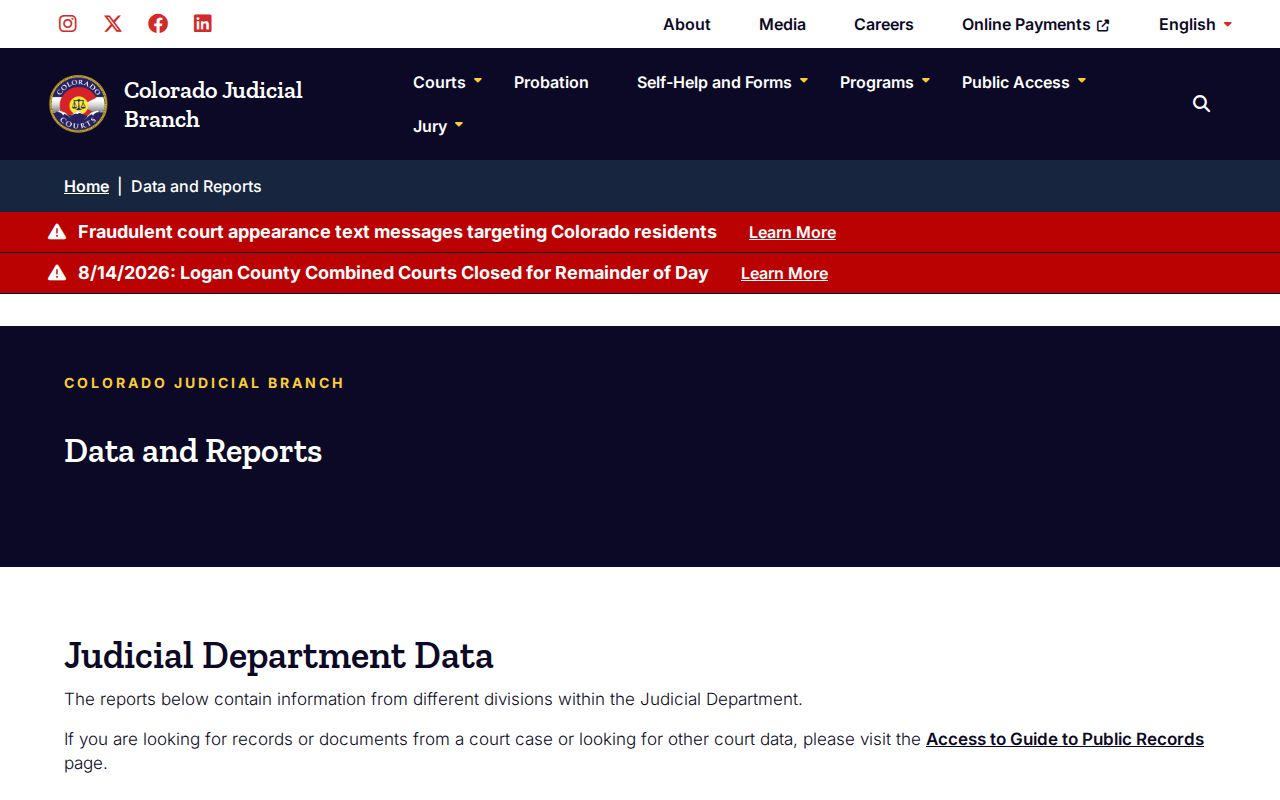
Those state reports supply context in the aggregate. They are no stand-in for the Lake County clerk's official file or a federal PACER docket. The U.S. District Court for the District of Colorado names the federal trial court that serves Lake County.
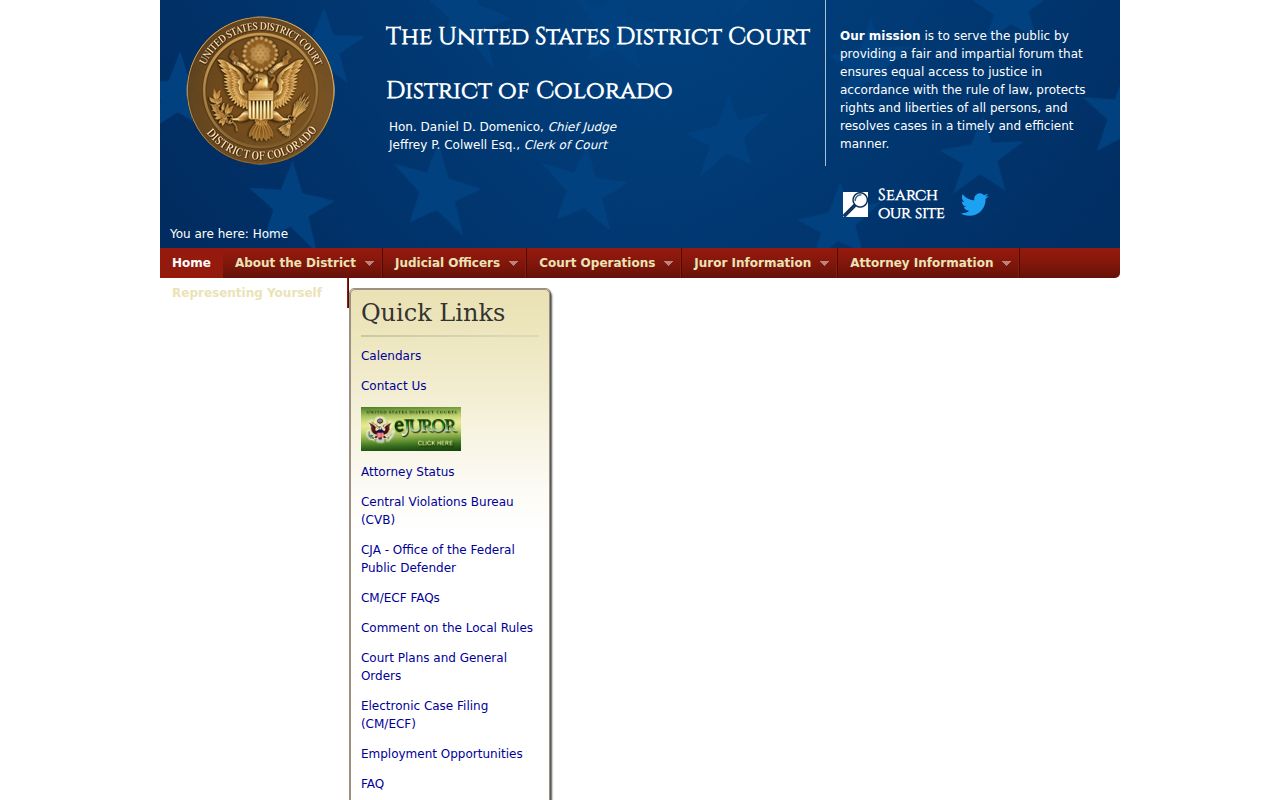
That federal court keeps its own docket and its own documents. The Lake County Combined Court clerk therefore cannot certify a federal filing. For a direct case lookup, use the official District of Colorado PACER and CM/ECF query.
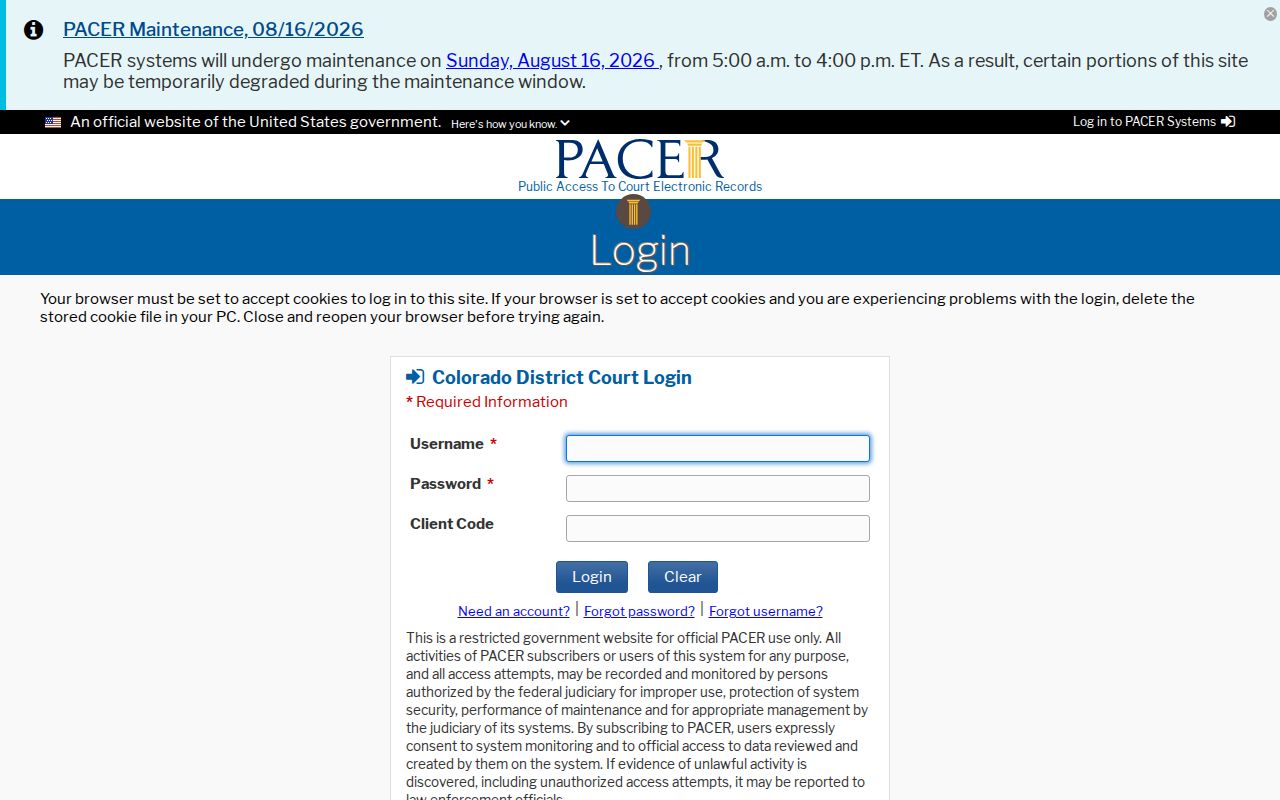
Federal filings follow their own rules, not the ones that govern a Lake County state-court docket. Anyone searching federal case numbers or party names by those rules can register with PACER, the federal judiciary's public records service, which also offers a nationwide Case Locator for finding cases across districts.
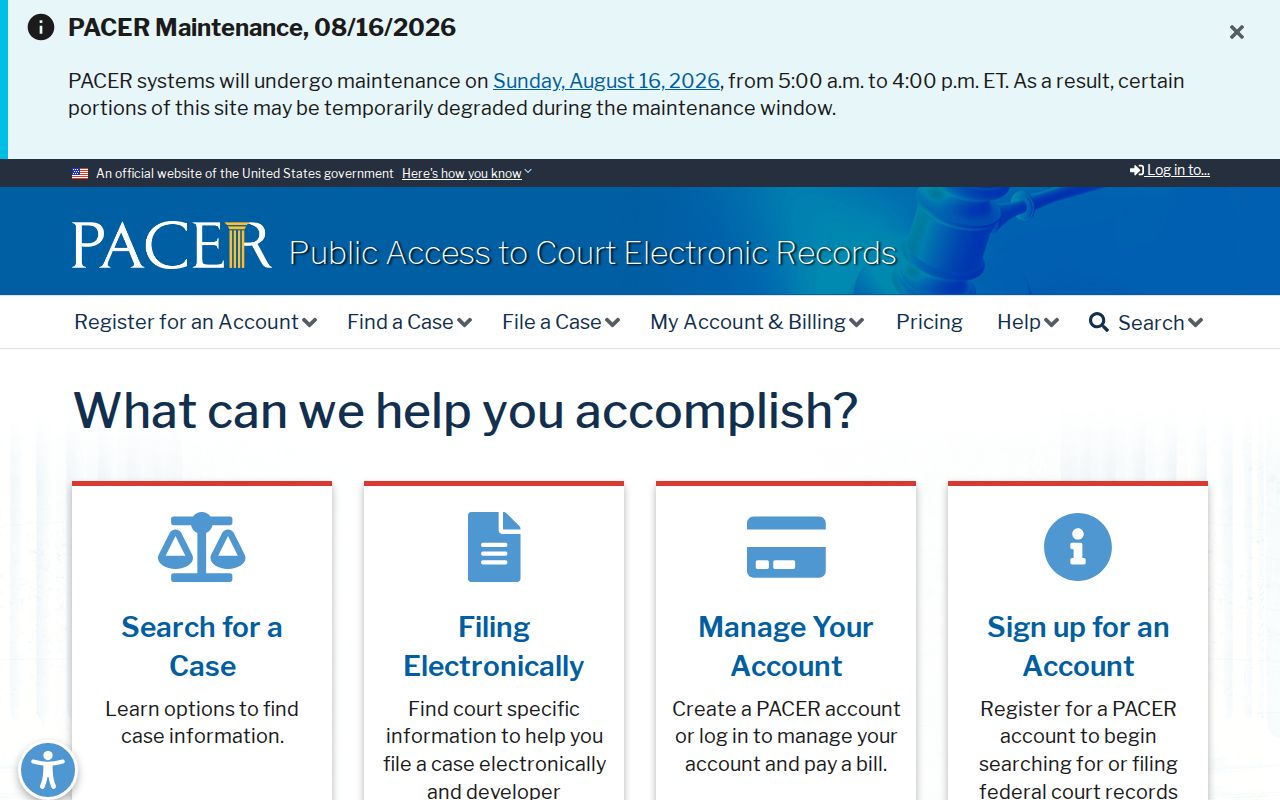
Not sure which federal district holds the file? The nationwide locator is built for that. It cannot reach Lake County District or County Court records, though, so state-level docket searches still go through the county's own courts. For bankruptcy matters, the U.S. Bankruptcy Court for the District of Colorado maintains the case files and its page explains how to access them.
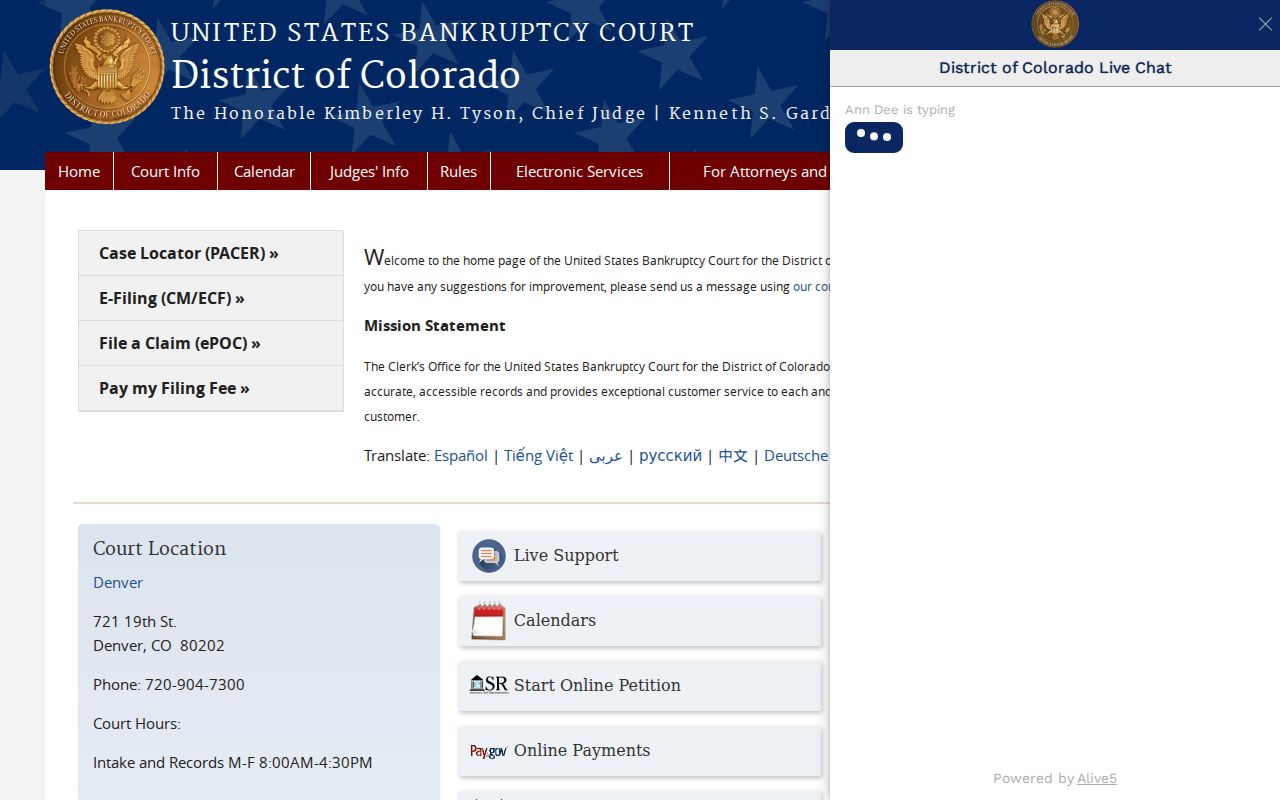
Bankruptcy is different. A bankruptcy docket never passes through the Leadville clerk, so request it straight from that court or search it through PACER. Federal appeals take one more hop: cases from the district court land in the U.S. Court of Appeals for the Tenth Circuit, which posts its own docket information for anyone tracking an appeal.
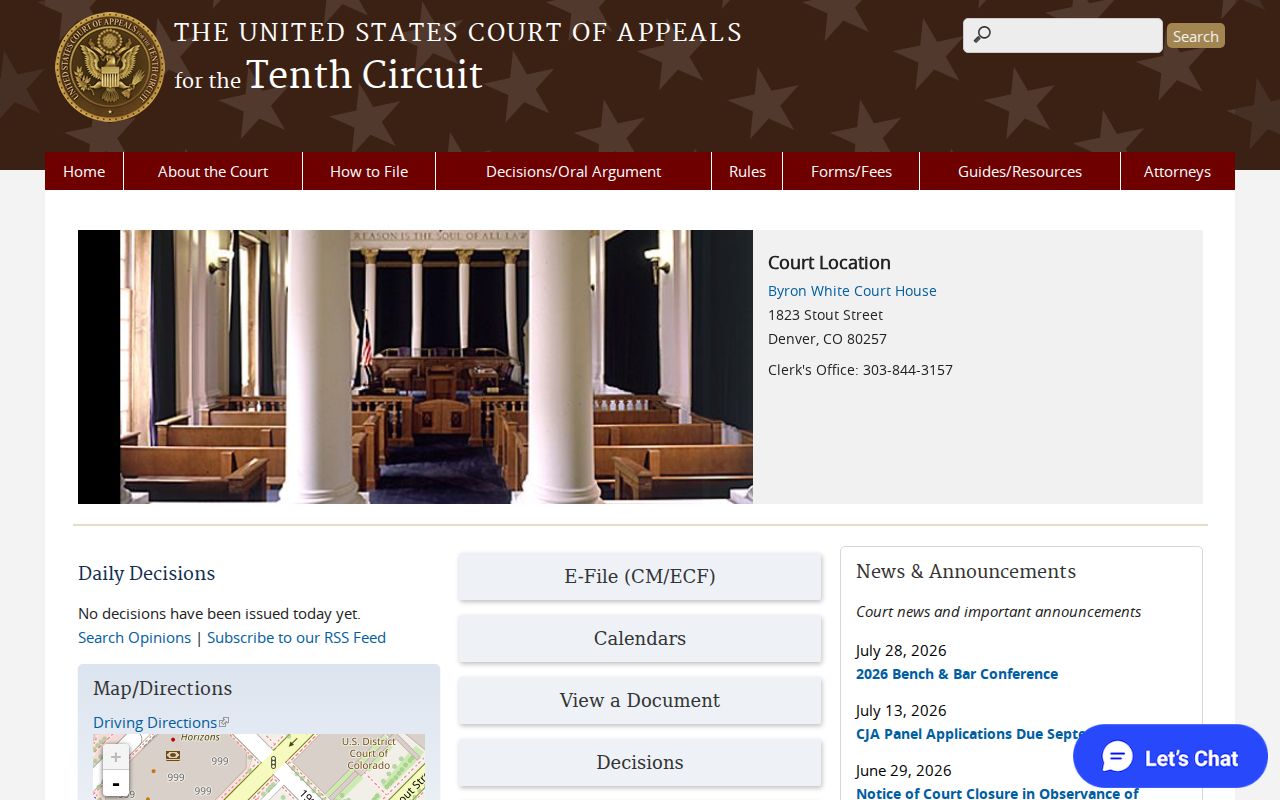
Federal appeals travel a different path. The Tenth Circuit keeps its own appellate record, while a Colorado Court of Appeals case sits in a separate state docket once an appeal is filed.