
Searching the Lake County Court Docket
Colorado's free Judicial Branch Docket Search is the natural place to begin. It is a Lake County hearing hunter's first stop. One caution up front. It scans a calendar of settings, not a library of filed papers. Pick the 5th Judicial District and Lake County. Then let the form guide you to a courthouse or court type. You must supply a date or a date range, plus at least one more filter. The extra filter can be a location, case segment, party, attorney, or division. A date by itself gets you nowhere.
Work from the notice, ticket, or order in hand whenever you can. Those papers usually give you the court. They also carry the filing year, the case class, and the sequence number. Spell names exactly as the court spelled them. Pull a broad party search and you may see people from other Colorado counties. A Lake County location filter cuts that same-name noise. Treat what comes back as a schedule of settings. It can show a date, court, case number, and hearing line. But it is not the official register of actions and not the filed order.
- Identify District Court, County Court, or Leadville Municipal Court from the case type and paperwork.
- Open the state docket search and select Judicial District 5 and Lake County.
- Choose a date plus a case, party, attorney, division, or location filter.
- Match the court, case number, caption, and newest setting rather than relying on one name.
- Ask the Lake County Combined Court for the ROA or exact document when the calendar is not enough.
The official search screen lays out the public controls a Lake County court docket search uses.
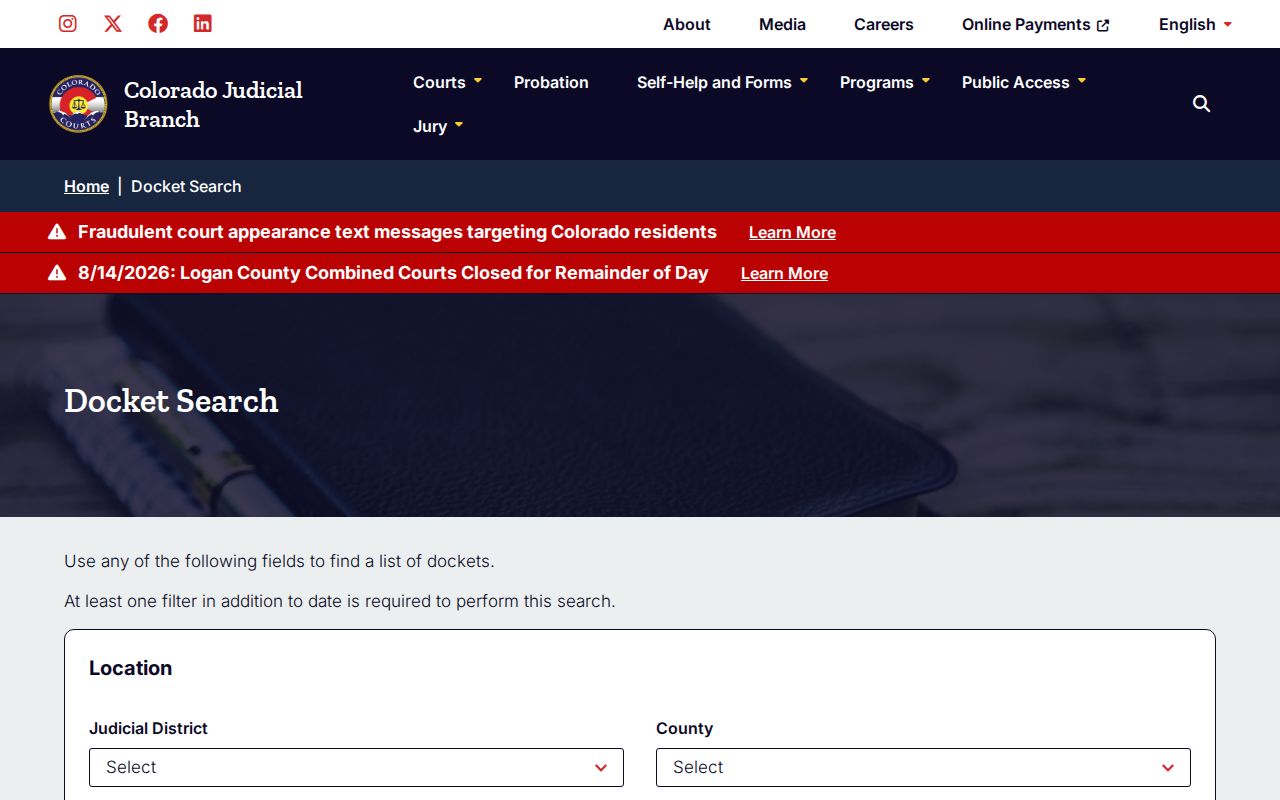
Those filter requirements are why pairing a date with a second piece of case information yields a steadier Lake County result. One field alone rarely pins down the right docket entry.
Lake County Docket Clerk Mix-Up
The courthouse address hides a local trap. The Lake County Combined Court and the elected Lake County Clerk and Recorder both sit at 505 Harrison Avenue. Even so, they keep entirely different records. Chelsea Prugh is the state Judicial Branch Clerk of Court named on the official judges and staff page. She maintains the District Court and County Court files. The elected recorder's world is deeds, elections, motor vehicle work, and other county business. Ask that office for a certified criminal judgment or a civil ROA. You are at the wrong counter.
Leadville adds a third office to the mix. Its Municipal Court clerk keeps ordinance and municipal traffic files at City Hall. A city citation does not belong at the Combined Court just because both doors open in Leadville. Read the ticket or the caption first. State felonies, misdemeanors, state traffic, small claims, probate, domestic, and civil matters run through the Combined Court. Leadville code cases go to the city clerk. The official court staff listing names the Lake County court clerk. It also gives the public contact channel.
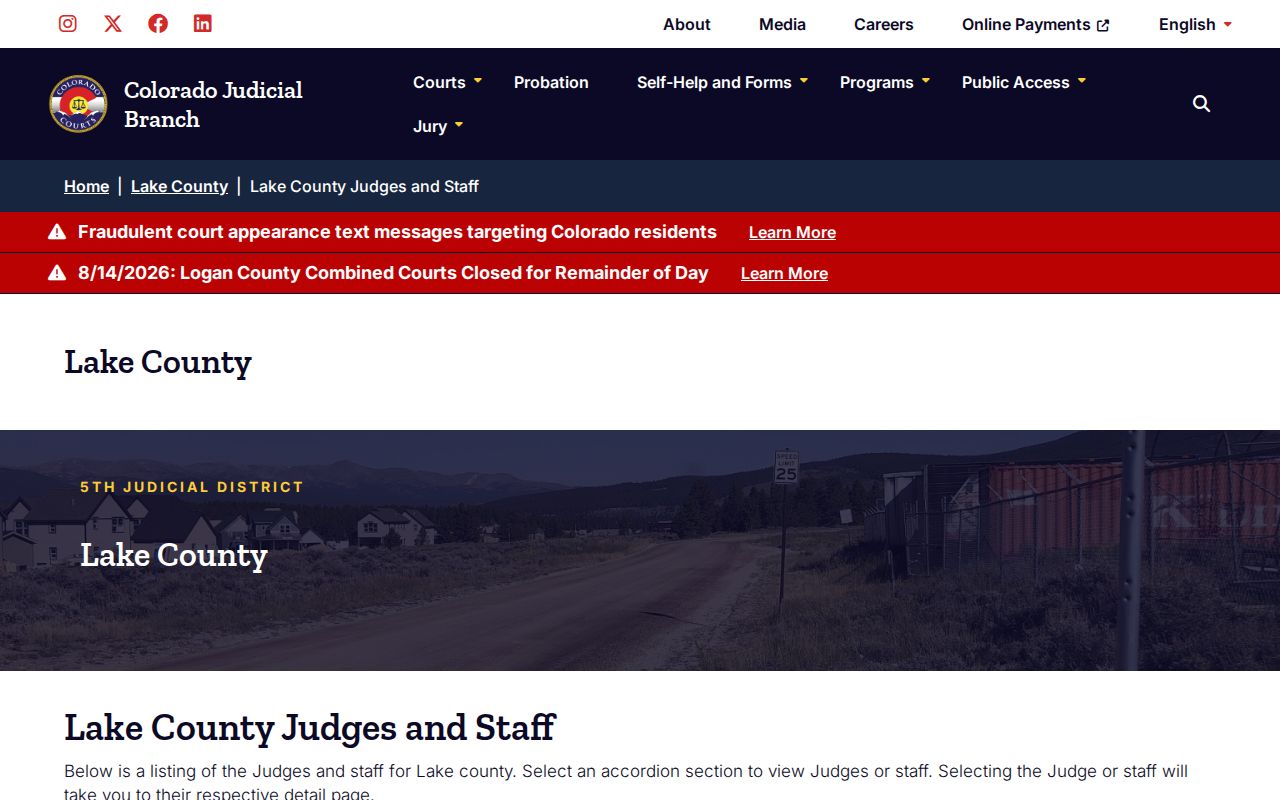
Keeping that distinction straight sends a court-record request to the judicial clerk rather than to the county land-record office.
Inside a Lake County Court Docket
In Colorado, a docket is the court's scheduled case list, while the Register of Actions, usually shortened to ROA, is the chronological index of the case. A Lake County calendar result can carry a date, time, estimated duration, caption, case number, hearing type, court location, appearance type, and courtroom. The ROA reaches deeper. It can list filings, service, minute orders, motions, settings, rulings, and the recorded disposition in date order. Neither one promises that every filed image is online.
| Case number | A four-digit year, case-class letters, and sequence, such as 2026-CR-123. |
|---|---|
| Caption and parties | The formal case heading and the roles of the named parties. |
| Entries and filings | Dated references to pleadings, service, motions, minute orders, and later case events. |
| Hearing settings | The court date and event label, with appearance type or courtroom when the public entry supplies them. |
| Court and division | Lake County District Court or County Court and the assigned judicial work unit. |
| Disposition | A recorded outcome entry. The signed order supplies the authoritative terms. |
Lake County Docket Case Classes
Case-class letters steer a Lake County docket search toward the right stream. They say nothing about outcomes. CR usually marks a District Court criminal case. M and T mark the misdemeanor and traffic streams in County Court. CV covers District Court civil work, while C and S cover county civil and small claims. DR is domestic relations, JV or JD signals juvenile matters, PR is probate, and CW is water. When the class on your case paper differs from this common map, the paper wins.
- CR and CV
- District Court criminal and general civil classes.
- M, T, C, and S
- County Court misdemeanor, traffic, civil, and small-claims classes.
- DR and PR
- Domestic-relations and probate matters, often with tighter document access.
- ROA
- The Register of Actions, a date-ordered index of case events rather than a folder of document images.
Enter all three parts of a case number whenever you know them. A guessed class can make a live Lake County case look like it does not exist.
Courts That Keep Dockets in Lake County
Lake County sits in Colorado's four-county 5th Judicial District. The District Court is the general-jurisdiction trial court. It holds felony, major civil, domestic-relations, juvenile, probate, and water cases. Lake County Court is a separate state trial court of limited jurisdiction. It covers misdemeanors, state traffic, small claims, and county civil matters. Both share the Combined Court clerk and counter. Leadville Municipal Court, a local court of record for city-code cases, is not a branch of County Court.
| Court | Docket Covers | Where to Search |
|---|---|---|
| Lake County District Court | Felony, general civil, domestic, juvenile, probate, and water matters | Colorado Docket Search, then Combined Court clerk |
| Lake County Court | Misdemeanor, state traffic, small claims, and county civil matters | Colorado Docket Search, then Combined Court clerk |
| Leadville Municipal Court | Leadville ordinance and municipal traffic matters | Ticket, city calendar, and Municipal Court clerk |
Lake County Docket Calendar Layers
Colorado's free statewide search does one job well. It tells you which public Lake County cases are set for a hearing on a date you pick. That is all it does. No charges, no pleas, no judgments, no bond amounts, no attorney lists, and no document images come back with it. For deeper court docket detail, Judicial Branch-approved commercial vendors sell real-time ROA access searchable by name or case number. That access covers many civil, water, small-claims, domestic, felony, misdemeanor, and traffic matters. Colorado itself cautions that vendor data can miss a case entirely or carry errors. It is never the official court record.
Think of the docket search in three layers. A calendar entry tells you when and where. The ROA tells you which procedural steps were entered on the court docket. The filed paper tells you what the judge or a party actually said. Add a certified copy and the clerk authenticates it. Anyone who needs an order, complaint, judgment, ticket, or certified ROA should go past the search result. Use the state Record/Document Request Form or the Combined Court counter.
The Judicial Branch access guide lays out the difference between requesting a case file and requesting court administration records. It gives the steps for each.
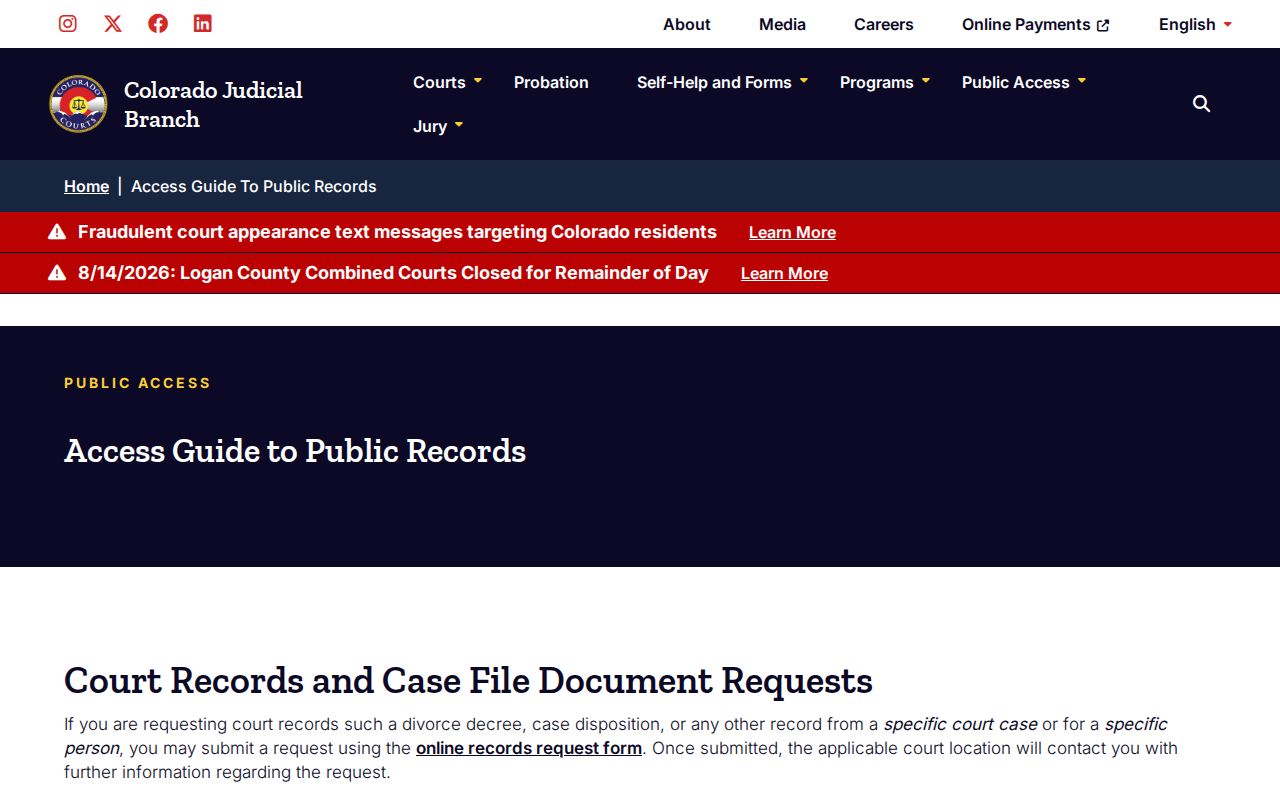
That split explains the routing. A court judgment follows the Judicial Branch route, while a Lake County administrative record can follow CORA.
How to Find Court Dates and Settings
Start with a date and Lake County. Then match the full case number and the right court. A docket label names the setting. It could be an arraignment, bond hearing, pretrial conference, motions hearing, disposition, sentencing, trial, or review. The label reports a time, not a guaranteed slot. Lake County warns that traffic arraignment dockets can run large, and waiting to speak with the District Attorney may add hours.
Later entries control the schedule. A continuance or reset moves a setting; a vacated entry removes it. When vendor access is available, check the newest notice or minute order, and call the Combined Court at 719-293-8100 about a near-term conflict. The full Lake County court dates process also covers appearance type, same-day closure checks, and missing courtroom details. For a Leadville ordinance matter, confirm with the municipal clerk, since the city calendar conflicts on whether monthly court falls on the second or third Wednesday.
Note: a virtual courtroom link alone does not authorize remote appearance. County Court requires an advance motion before its judge.
Lake County Missing Docket Results
A blank results page proves nothing. A Lake County case may still exist. Try the wrong court, class, date, or party spelling first. The file may be old and stored off site. It may also be juvenile, sealed, suppressed, or otherwise restricted. Some probate and family documents carry narrower access. The public may still see that a case number exists. Leadville ordinance cases are different. They may not show up in the state search at all.
Go back to the source paper first. Change one filter at a time, keeping Lake County selected. If the case number is known, try the full year, class, and sequence. For an older file, ask the Combined Court whether actual retrieval costs apply. The statewide request form warns that a restricted record may need government photo identification. It may also require proof of authority. The clerk cannot release sealed material just because a public request was filed.
Key point: An absent web result can reflect access rules or search limits. It is not proof that the case was never filed.
Public Access to Court Dockets
Colorado Judicial Branch access rules govern Lake County court files first, not the county's general public-record form. Chief Justice Directive 05-01 grants reasonable public access while shielding confidential information. Public access does not put every image online. State fee authorities set the court-copy charges and the authentication rules. CORA covers Lake County administrative records. It is no substitute for the court-case request route.
Key Rules:
Chief Justice Directive 05-01 governs access to Colorado Judicial Branch court records.
C.R.S. § 13-32-104 supports court copy and certification charges.
CORA, C.R.S. §§ 24-72-201 through 206 covers county administrative records rather than the court case file.
Colorado Title 19 limits ordinary public access to juvenile and child-welfare information.
The official CJD 05-01 page governs access to a Lake County court docket.
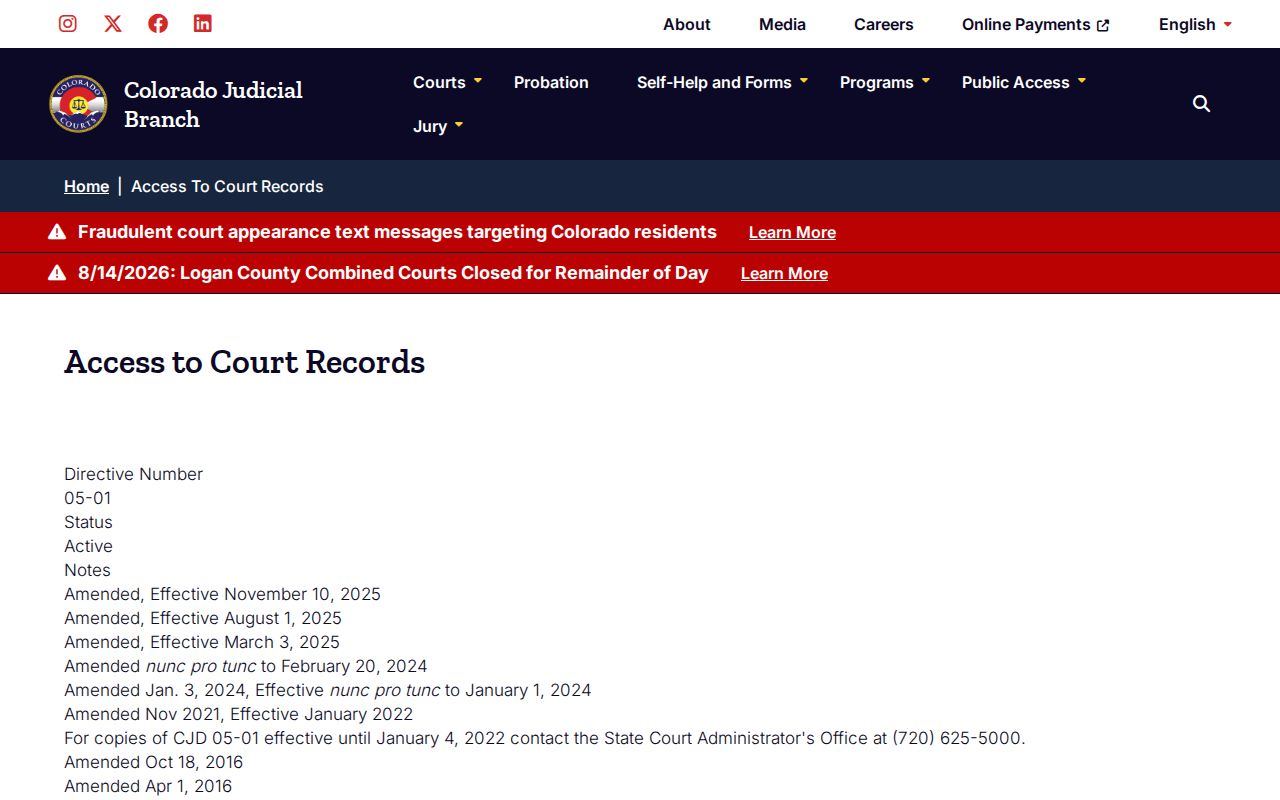
It covers redaction, document security levels, and remote-access limits.
Lake County Docket Security Levels
Colorado Courts E-Filing applies five security labels. Public material is open to the court, the parties, and the public. Protected material turns public after required redaction. Restricted material stays with court staff, parties and counsel, and defined justice agencies. Suppressed material is tighter still. Sealed material is generally for judges and Judicial Department staff only. The label says who may see a filing, not how the case is decided.
Juvenile and child-welfare cases take a different path. They do not follow the public route of ordinary adult civil or criminal dockets, and some probate, protection-order, and domestic records hold protected details too. Sealing is not deletion from the court's internal system. A sealing order changes public access. The court and other legally authorized users keep theirs. The Chief Justice Directives index gathers Colorado's access, fee, electronic-access, and e-filing directives.
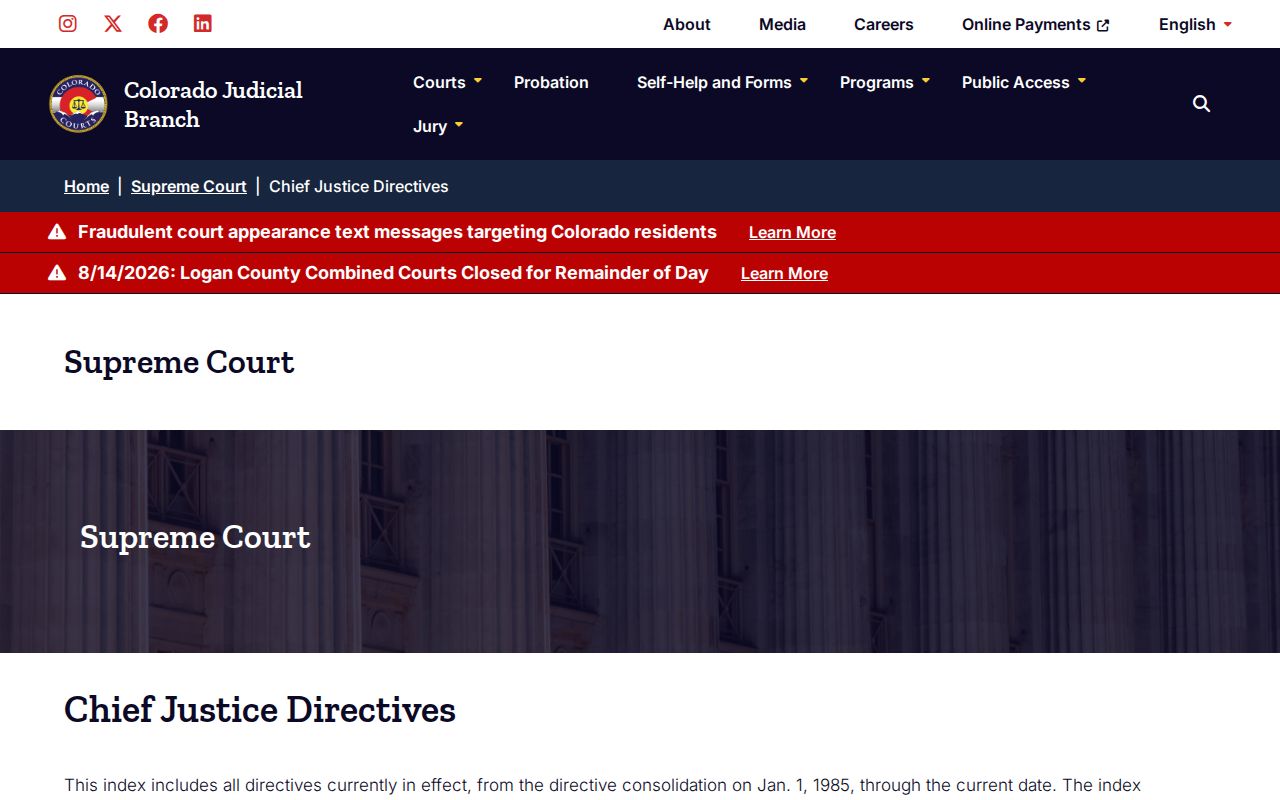
Those directives guide Lake County clerk decisions on inspection, copies, and protected documents.
Docket Records at the Clerk's Office
For an ROA, complaint, order, judgment, ticket, or certified court document, the Lake County Combined Court clerk is the official source. Requests go through the statewide form, at the counter, by mail to P.O. Box 55, or after calling the office to confirm the current procedure. The form's ordinary response time is within three business days, unless retrieval, volume, redaction, or another circumstance requires more. Copies cost $0.25 per page. Certification or exemplification costs $20 per document. A name search costs $5. Off-site retrieval is billed at actual cost.
Filed records are one thing. A verbatim transcript follows another channel. Most 5th District proceedings are digitally recorded. Raw audio is not routinely released, because courtroom microphones can capture confidential conversation. Ask the court about the authorized reporter or transcription process. Certification cannot overcome a sealing order or any other access limit.
Lake County Combined Court Clerk
505 Harrison Avenue, P.O. Box 55
Leadville, CO 80461
719-293-8100; clerk 719-293-8105
Lake County Docket to Order
Decide what paper you actually need before the request goes in. A calendar check is free. It confirms the next hearing date. A register of actions gives the full case chronology, a filed order gives the judge's actual language, and a certified copy proves the clerk authenticated the paper. Asking for “everything” adds cost and delay. Naming one order, ticket, judgment, or disposition keeps the Lake County search precise.
The statewide form wants your contact details and address. It also asks for the case number if known, plus the case type, filing year, party information, and the desired document. Lake County is named as the record location. Checkboxes cover common criminal, civil, family, and probate records. Mark certified or exemplified only when that level of authentication is required. Suppressed, juvenile, probate, or protected requests may trigger an identification request.
The Colorado court-file request form shows every field and record choice a Lake County requester will face.
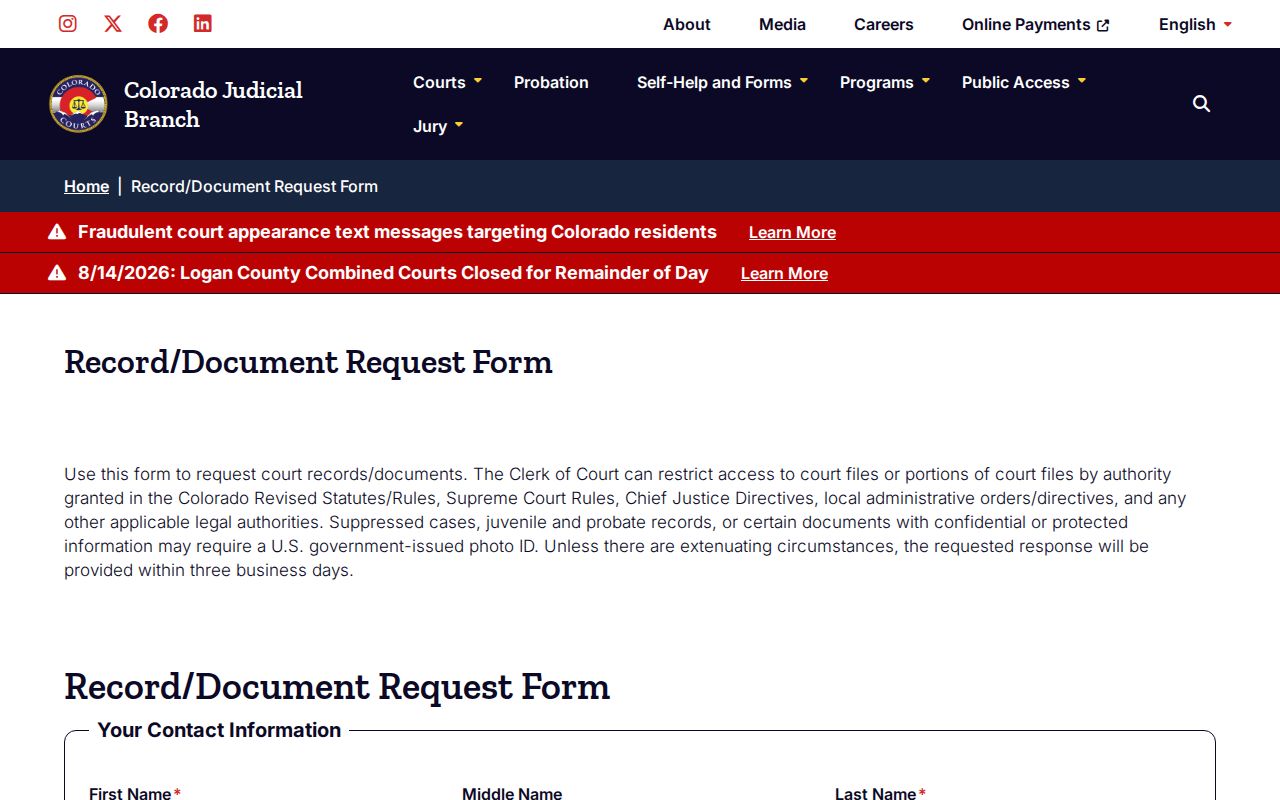
That single form bridges the gap between a Lake County docket reference and the official paper the Combined Court clerk keeps. One request, and the record follows.
Lake County's Combined Court
Both trial courts answer to one door. The District Court and the County Court share a building and a single clerk office, yet each keeps its own jurisdiction and case classes. Notices on the local page can affect a visit or a hearing, so glance at them before heading over. The offices, including probation, are open on weekdays. Exact opening and closing times are not published. The Lake County Combined Court page pulls both courts' access channels into one place, and it is the spot to confirm details before a long trip.
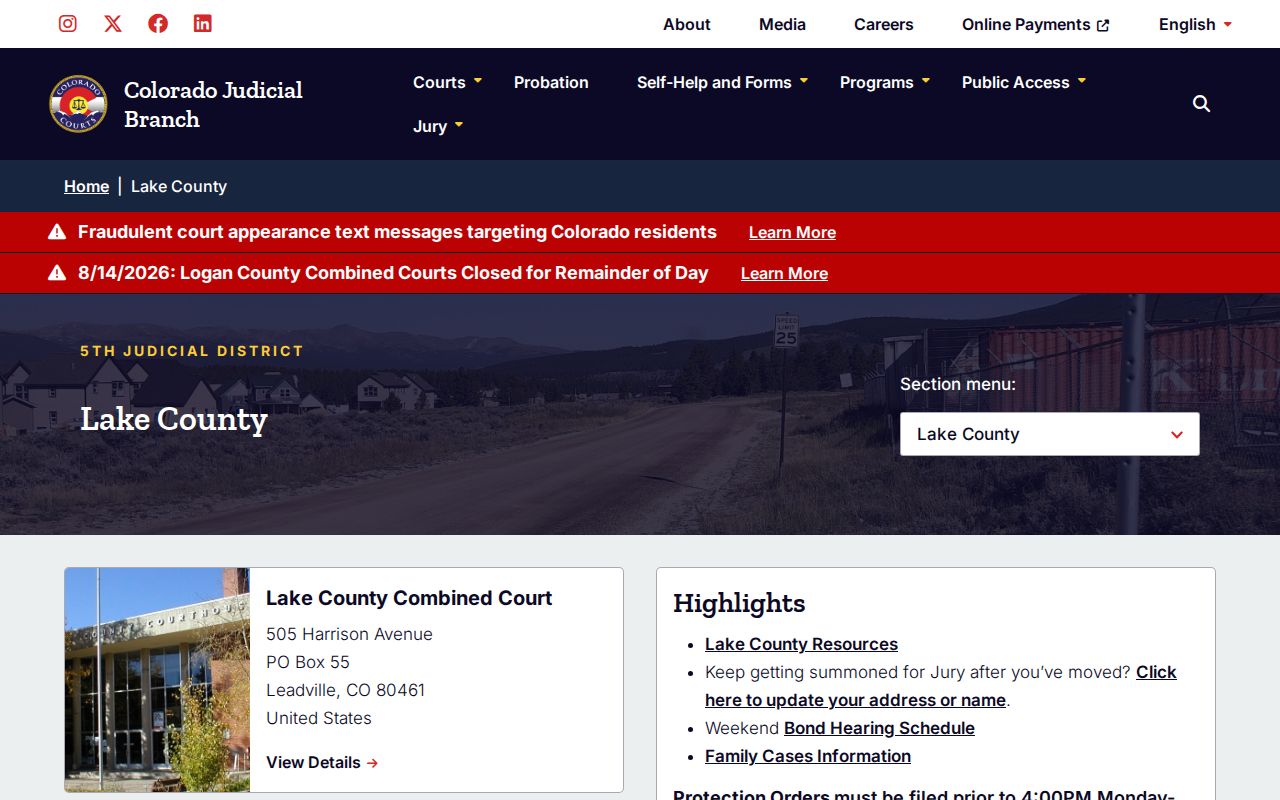
The local court page comes first. It carries current contact details, closures, payment guidance, and remote-hearing instructions.
Two local limits matter. Protection-order papers must reach the clerk before 4:00 p.m. for same-day processing and judicial review. The clerk also closes for lunch from noon to 1:00 p.m., and current local material lists a second-Monday staff closure from 11:00 a.m. to noon. None of this changes a docket entry. It only shapes when staff can help in person.
Lake County E-Filing and Dockets
Colorado Courts E-Filing moves documents into covered District Court and County Court case classes. It is not the public docket viewer. Statewide testing began in the late 1990s. District Court e-filing went statewide in 2001, County Court civil filing followed later, and Colorado now runs a broad state EFS. E-filing acceptance can create a case event. The public still reaches records through the docket search, an approved ROA vendor, or the clerk's request process.
That split prevents a common mistake. You never need to log into an e-filing service to search a public Lake County calendar. Nor does a calendar result open the document repository. Attorneys and parties file through CCE. Everyone else finds a setting through the docket interface. Official papers still come from the clerk. Current standards under CJD 11-01 push uniform electronic transmission and fewer conflicting local rejection rules.
Lake County Court Dockets by City
Leadville is Lake County's only incorporated municipality. It hosts the county's only municipal docket page. The 2020 Census source counted 2,633 residents. Leadville Municipal Court handles city ordinance and municipal traffic matters at City Hall. State traffic, misdemeanor, felony, and civil cases arising inside the city belong to Lake County Court or District Court instead. Twin Lakes is different. The Census profile for Twin Lakes lists it as a census-designated place rather than a municipality, so no separate municipal court operates there.
Leadville Docket Search
Population 2,633 · Municipal ordinance and city traffic court records
Map and Directions to the Lake County Combined Court
District Court and County Court case files for Lake County are kept at the Combined Court, 505 Harrison Avenue in Leadville. The same building also houses the elected Lake County Clerk and Recorder, which handles deeds, elections, and vehicle titles rather than court records, so a visitor should ask specifically for the Combined Court clerk.
Lake County Combined Court
505 Harrison Avenue, P.O. Box 55
Leadville, CO 80461
719-293-8100; clerk 719-293-8105
Open to the public Monday through Friday; the office closes for lunch from noon to 1:00 p.m., plus a second-Monday staff closure from 11:00 a.m. to noon
No precise daily opening or closing time is published beyond the weekday schedule, so call before a long trip. Protection-order papers should be filed before 4:00 p.m. for same-day judicial review, and traffic arraignment dockets can run long, with a wait of a couple of hours before a judge or clerk reaches the matter.