
Searching Lake County Criminal Dockets
Start with the Colorado Judicial Branch Docket Search filtered for Lake County when you need a hearing date. Pick the 5th Judicial District. Then choose Lake County, District or County Court, and a date or range. One more filter is required. Add a case number segment, party name, attorney, or division. A date alone will not run. CR marks a District Court criminal matter. Use it only when the paperwork confirms that class. M and T usually signal County Court misdemeanor and traffic cases. If the notice shows a different code, trust the notice.
Remember that a calendar result is just a list of settings. The complaint, the signed sentence order, and the full register of actions stay behind it. Searching by exact case number beats searching by name, because names repeat across Colorado counties. Match the court, location, caption, and hearing type before you rely on any docket result.
- Identify whether Lake County District Court, Lake County Court, or Leadville Municipal Court issued the case.
- Select Lake County and the proper court, date range, and class in the free docket search.
- Add the year, class, and sequence, or use an exact party or attorney name.
- Read the newest setting and confirm the location, appearance type, and courtroom.
- Ask the Combined Court clerk for the ROA or signed filing when the calendar is not enough.
Lake County Criminal Case Classes
Class letters route a Lake County criminal docket before you read a single event. CR matters land in District Court. M and T matters belong to County Court streams. R is another confirmed criminal-side class on Colorado forms. JD marks juvenile delinquency, and access there is tighter. Each identifier combines a four-digit filing year, the class, and a sequence, like 2026CR123. Punctuate it exactly as the case notice does.
The Colorado trial-court district map places Lake County inside the four-county 5th Judicial District. That map explains why the district label matters. It also shows why the Lake County courthouse selection matters in a criminal docket lookup.
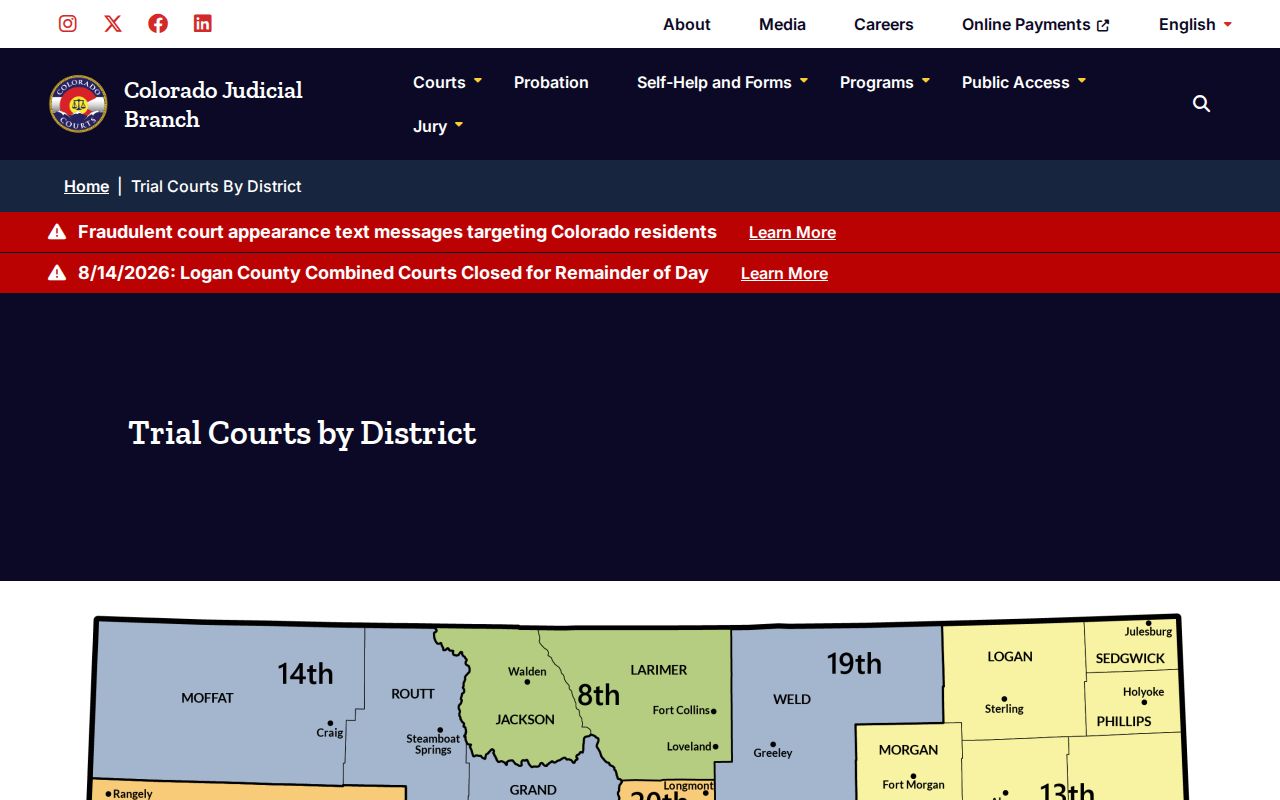
Sharing a district does not merge records. Clear Creek, Eagle, and Summit cases stay in their own courthouses. Keep Lake County selected so your docket results come from the right one.
- CR
- District Court criminal class, commonly used for felony cases.
- M
- County Court misdemeanor class.
- T
- County Court traffic class.
- JD
- Juvenile delinquency class with restricted public access.
Inside a Lake County Criminal Docket
A Lake County criminal calendar result can list the date, time, estimated duration, caption or party name, case number, hearing type, location, appearance type, and courtroom. Common labels include First Appearance, Arraignment, Appearance on Bond, Hearing on Bond, Preliminary Demand, Status Conference, Motions Hearing, Disposition Hearing, Hearing on Probation, and Sentencing Hearing. Appearance may read IN PERSON, VIRTUAL, TELEPHONE, or nothing. A blank field means confirm directly with the court. It is never permission to pick your own appearance method.
| Case number | Year, class, and sequence, such as 2026CR123, tied to a specific court. |
|---|---|
| Setting | The date, time, hearing label, estimated duration, location, and available appearance details. |
| Charging entry | A Complaint or Information entry points to the charging paper, which must be requested for its exact words. |
| Minute order | A recorded court action following a hearing; its text is more useful than the calendar label alone. |
| Disposition | The recorded resolution, confirmed through the signed disposition or sentence order rather than a future setting. |
The free Lake County criminal docket stops at the calendar. No charges, statute numbers, bond amounts, pleas, sentences, attorney lists, financial detail, document images, or full disposition appear there. Those facts live in the ROA or filed record.
Lake County Criminal Hearing Labels
A scheduled event tells you what should happen next. It does not tell you what a judge has already decided. "Hearing on Bond" deals with release terms, and "Hearing on Probation" with later compliance. "Disposition Hearing" trips people up most. It only names a setting where the case may resolve. It is not proof of a plea, dismissal, trial finding, or sentence. The Lake County court publishes no local abbreviated disposition-code sheet. Do not rely on imported code lists.
Read the Lake County criminal ROA in order. Begin with the Complaint or Information. Then find the first appearance or arraignment and any bond minute orders. Track counsel appearances, preliminary events, status conferences, motions, and resets. A plea entry or trial finding is not the same as a scheduled disposition hearing. The signed Disposition/Sentence Order holds the official result. Sentencing follows a conviction or accepted plea. The Lake County court states that fines are due at sentencing.
Key distinction: a calendar label tells why court time was reserved. A signed order states what the judge decided.
How a Criminal Case Moves
A Lake County criminal docket builds one entry at a time. A complaint or information opens the visible charging sequence. At the first appearance and arraignment, the court addresses advice of rights, counsel, plea, or next steps as applicable. Pretrial settings then track readiness, motions, negotiation, and trial preparation. A continuance or reset keeps its place in the history even after a newer date replaces it. So always read forward to the last entry.
Docket flow: Filing › Arraignment › Pretrial › Plea or Trial › Disposition › Sentencing
Not every Lake County criminal case hits each label in that form. Some end in dismissal before trial. A deferred judgment shows up only if the judge orders one. An appeal should produce a notice or order plus a new appellate identifier, which you then follow through the Colorado appellate docket. In every case, the entries and signed papers control over this general flow.
Lake County Criminal Orders and ROAs
A calendar entry rarely settles the real question. Often you need the paper itself. The Lake County Combined Court clerk issues official ROAs, Complaints or Informations, Disposition/Sentence Orders, plain copies, and certified copies. Access rules decide what you can get. Start with the state Record/Document Request Form, pick Lake County, add the case number and party details, and name the exact criminal item. Email works too, at LakeRecordsRequest@judicial.state.co.us.
Need the counter? It sits at 505 Harrison Avenue in Leadville. Mail goes to Lake County Combined Courts, Attn: Records, P.O. Box 55, Leadville, CO 80461. For records, call 719-293-8100 ext. 9; the Clerk of Court is 719-293-8105. The current fax reads 719-293-7420, though older listings disagree, so verify before sending. Expect a routine answer within three business days. Buried files may add retrieval cost.
Copy and certification costs come straight from the Judicial Branch's court fee list. That page sets what the clerk charges for plain copies, certification, and exemplification.
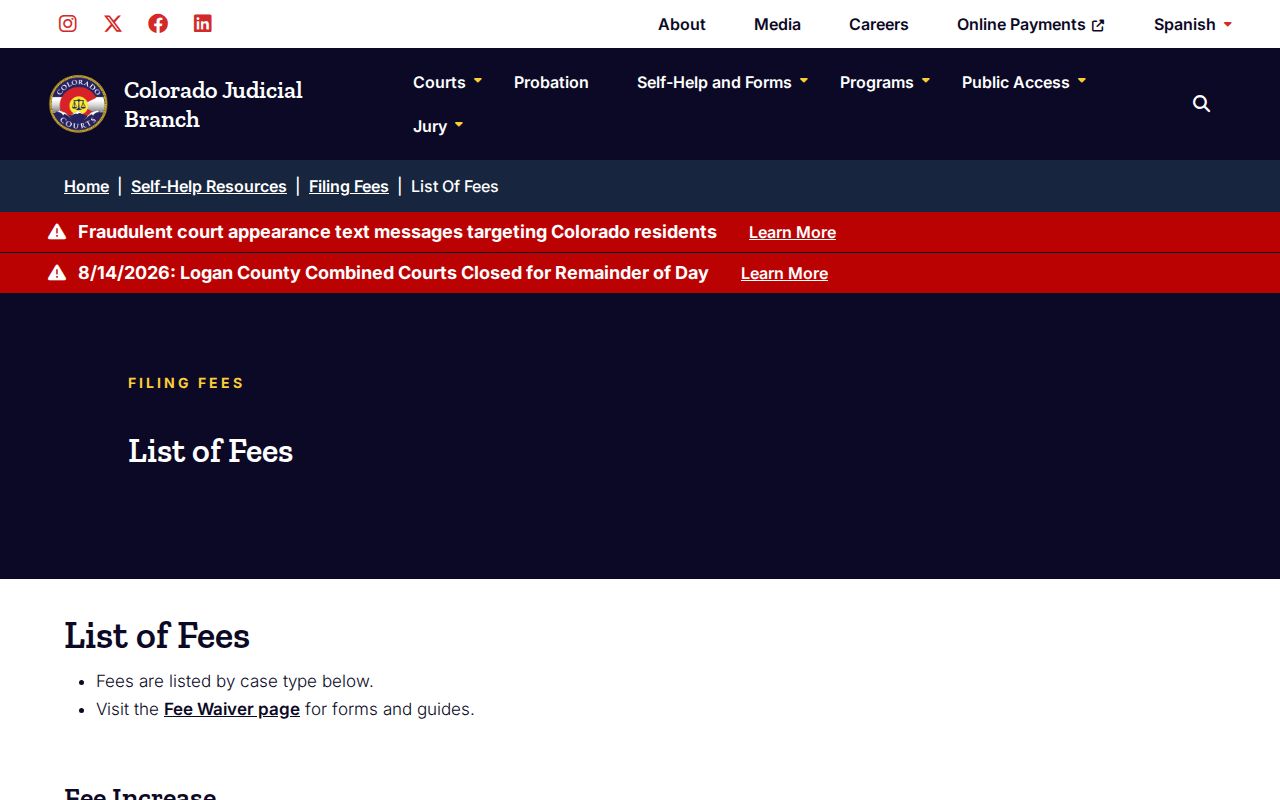
Plain copies run $0.25 per page, a name search costs $5, and certification or exemplification adds $20 per document. Ask the clerk to confirm the total before mailing payment.
Courts That Hold Criminal Dockets
Lake County District Court holds the felony dockets. Misdemeanors, state traffic matters, and preliminary felony-complaint activity belong to Lake County Court. Both sit inside the Lake County Combined Court and share one Judicial Branch clerk office. Juror instructions run through the official Lake County jury channel. The shared counter does not erase the split. A CR case and an M case can carry different jurisdiction, procedure, and docket paths even though one place handles both records.
Leadville Municipal Court works separately. It prosecutes Leadville ordinance violations and municipal traffic. Its own municipal clerk keeps that record. A city citation will not necessarily appear in the state docket or payment system. Read the ticket. If it names the city court, contact Leadville Municipal Court. Sheriff incident, arrest, and jail files sit apart too. They may describe law enforcement activity, but they never replace the court's Lake County criminal docket or its signed orders.
Lake County Criminal ROA Access Layers
Colorado layers access three ways. The free docket search shows when and where a public hearing sits. Nothing more. Approved commercial vendors sell a real-time register of actions, searched by name or case number. Coverage reaches only certain case types. The Judicial Department warns that vendor data is not the official record. A case may be missing. An entry may be wrong. And no filed document images appear. For an authoritative Lake County criminal ROA, complaint, order, or certified copy, go to the Combined Court clerk.
The Judicial Branch electronic access explanation names the approved vendor channel. Security limits on electronic court information are spelled out there too.
The chain is practical. The free Lake County calendar confirms a setting. A vendor ROA can index events unofficially when that helps. The official document comes from the clerk. Colorado Courts E-Filing, by contrast, is the filing system, not a public document viewer.
Lake County Competency Docket Privacy
The 5th Judicial District runs one district-wide Competency Docket for people facing competency matters. It serves the whole district. Treat that as the program. Do not assume a separate Lake County treatment court exists. A public criminal calendar may still list a setting tied to the underlying case. The rest stays quiet. Treatment, evaluation, medical, and mental-health detail can be restricted or suppressed. That split is deliberate. A setting still tells you when the case returns to court. For the current program name or eligibility, call the 5th Judicial District Court Executive at 970-328-4487. You can also ask the Lake County Combined Court clerk. A spare calendar entry is never the whole story of the proceeding.
Sealed Dockets and Public Access
Colorado's access rules govern adult Lake County criminal dockets. Even so, public status does not put every file or image online. Public documents may be inspected as allowed. Protected records turn public only after required redaction. Restricted records stay with specified court users, parties, counsel, and justice agencies. Suppressed records reach a narrower group. Sealed records go to judges and Judicial Department staff alone. Juvenile delinquency records skip ordinary adult access entirely.
A missing Lake County criminal docket result can mean several things. The court or class may be wrong, the name may vary, an old file may sit off-site, or an access limit may apply. Sealing does not delete the internal court record. And a sealing order binds the clerk; a filed request does not override it. Expect to show government photo identification for suppressed, juvenile, probate, or other protected material.
Key rules:
Chief Justice Directive 05-01 governs public inspection, copies, and electronic access to Colorado court records.
Colorado criminal-record sealing law explains how public access changes after a court orders or authorizes sealing.
Colorado Children’s Code confidentiality provisions restrict access to juvenile and child-welfare case information.